Showing posts with label CFD. Show all posts

Wednesday, 18 February 2009

Quadrics Customer Focus: BAE Systems


Electromagnetic, high power pulses, such as lightning, electrostatic discharge and electromagnetic pulse (EMP) represent the nature's most severe electromagnetic threats to aircraft.
A new Quadrics cluster has recently been deployed by BAE Systems for the computational processing required for high-fidelity whole vehicle simulations of the effects of lightning on aircraft.

Wednesday, 15 October 2008

The new supercomputer: Albert3


The new BMW Sauber supercomputer, Albert3, again with Quadrics interconnect, will have 4,224 processor cores and 50.7 Teraflops computing power.For more information please visit: bmw-sauber-f1 .


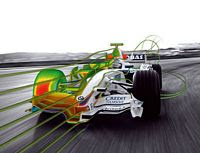
The BMW Sauber F1 Team presented its supercomputer Albert2 in December 2006. The 21-tonne facility for CFD calculations was already based on Intel technology (consisting of processors, the motherboard, chip set and server housing) and was at the time of start-up one of the most powerful in Formula One. Albert2 had 256 nodes with two Intel®Xeon® 5160 Dual Core processors each (two cores per processor). That amounted to a total of 1,024 processor cores. The capacity of the main memory was 2,048 GB and maximum computing power was 12.28 TFlops (12,288 GFlops). It wasn’t long before another 32 nodes were added, bringing the total to 288 nodes or 1,152 processor cores. Now the BMW Sauber F1 Team has ushered in the next stage and upgraded the existing computer. 384 nodes equipped with Intel®Xeon®E5472 Quad Core processors (four cores per processor) and related Intel technology have been added to the previous system, which means the new Albert3 supercomputer now has a total of more than 4,224 processor cores at its disposal. The computer’s RAM has grown to 8,448 GB and maximum computing power to 50.7 TFlops. That is a phenomenal 50,700,000,000,000 computations per second. To match this computing performance, the entire population of Munich and Berlin (4.7 million) would have to multiply two eightdigit numbers every three seconds for a whole year. In the current top 500 rankings of active supercomputers worldwide, this performance merits 45th place (third place among systems in industrial use). The new supercomputer, developed like its forerunner by the Swiss company Dalco and running on CFD software by Ansys-Fluent, weighs in at 38 tonnes yet has a footprint of just 24 square metres. The tremendous technical potential of Albert3 is harnessed for analysis in the field of aerodynamics. With its help, the specialists calculate components for the Formula One race cars, using grid models often made up of more than 100 million cells. CFD plays a particularly crucial role in the development of front, rear and auxiliary wings, as well as in engine and brake cooling. Computer-aided air flow simulation is not in competition with the work in the wind tunnel, but rather complements it. “A great advantage of CFD is that you can represent the air stream visually and that way understand why one component is better than another,” explains Willem Toet, Head of Aerodynamics. BMW Motorsport Director Mario Theissen says: “Unlike the other teams, we are not planning to build a second Formula One wind tunnel, but in future will continue to concentrate on the steadily expanding possibilities in the field of simulation.”

Acknowledgements: this article appeared on automobilesreview website on August 6th 2008.

Tuesday, 14 October 2008

Quadrics machines: Albert2 for BMW Sauber - Automotive

"Albert2" in January 2007 was the fastest Supercomputer in Europe and the third-fastest worldwide used in industry - to the BMW Sauber F1 Team for their demanding work in aerodynamics, with over 12 Tflop/s peak performance

The compute power will be used primarily for Computational Fluid Dynamics (CFD) calculations, using the ANSYS-Fluent software package, which is becoming increasingly important to compete for split-second advantages per race lap.
The Supercomputer was designed and built by DALCO using latest Intel Xeon technology to achieve its tremendous power. Thanks to the sophisticated design and the selection of the proper components "Albert2" is 5.5 times faster than its predecessor that is only two years old.
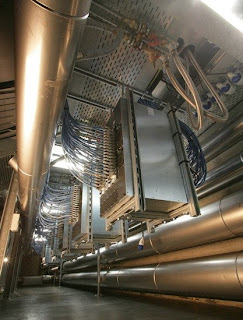
The compute section of the cluster consists of 512 Dual Core Intel Xeon 5160 processors (1024 processor cores), each running at 3.0GHz and with 4 Megabytes cache, 2,048 Gigabytes of physical memory and more than 20'480 Gigabytes of dedicated disk storage. These components are integrated with the Intel motherboard which uses sophisticated snoop filters for enhanced performance. Each compute node uses the Intel SR1500 chassis with optimized thermal characteristics. Two fail-safe Master units drive and supervise the computing complex.
"It is amazing how much performance we were able to get with the Intel Xeon technology in combination with the Fluent CFD software", stated Christian Dallmann, founder and CEO of DALCO. "My team can be very proud of having achieved the highest level of efficiency, which amazed experts." Francois Dallmann, lead engineer at DALCO, added: "These outstanding results are possible because of our extensive know-how in this area and the distinctive selection of top-quality components, combined with Swiss quality work."

Quadrics' ultra-low latency high-bandwidth interconnect which provides high, sustained performance for the complex data exchange among the processor cores was selected for this critical task because extensive benchmarks proved that it offered the best overall data rates and lowest latency.

All data files are stored on a Parallel Cluster file system. The demand for massive, parallel data movement is being met by the system's scalable performance and capacity based on an object-based approach to storage.
Data movement, job processing and cluster management is performed via a no blocking high performance Gigabit switch which provides full network bandwidth to every single compute node.
The cluster utilizes SUSE 64-bit open-source Linux, integrated and optimized using DALCO's own cluster management software including enhanced system and environmental monitoring and best practices.
The Supercomputer is integrated into ten water cooled racks from APC with an overall dimension of 10 metres wide, 1.2 metres depth and 2.3 metres height and total weight of 21 tons. The total power consumption under full load is 122 KW. Compared to its forerunner the new Supercomputer provides nearly 4 times the performance per Watt.

"Albert2" is capable of performing 12,288,000,000,000 calculations per second. To achieve the same computing performance, the entire population of Munich (1.3 million) would have to multiply two eight-digit numbers every three and a half seconds for roughly a year.

Announced in August 2008, the new BMW Sauber supercomputer, Albert3, again with Quadrics interconnect, will have 4,224 processor cores and 50.7 TFlops computing power.For more information please visit www.quadrics.com